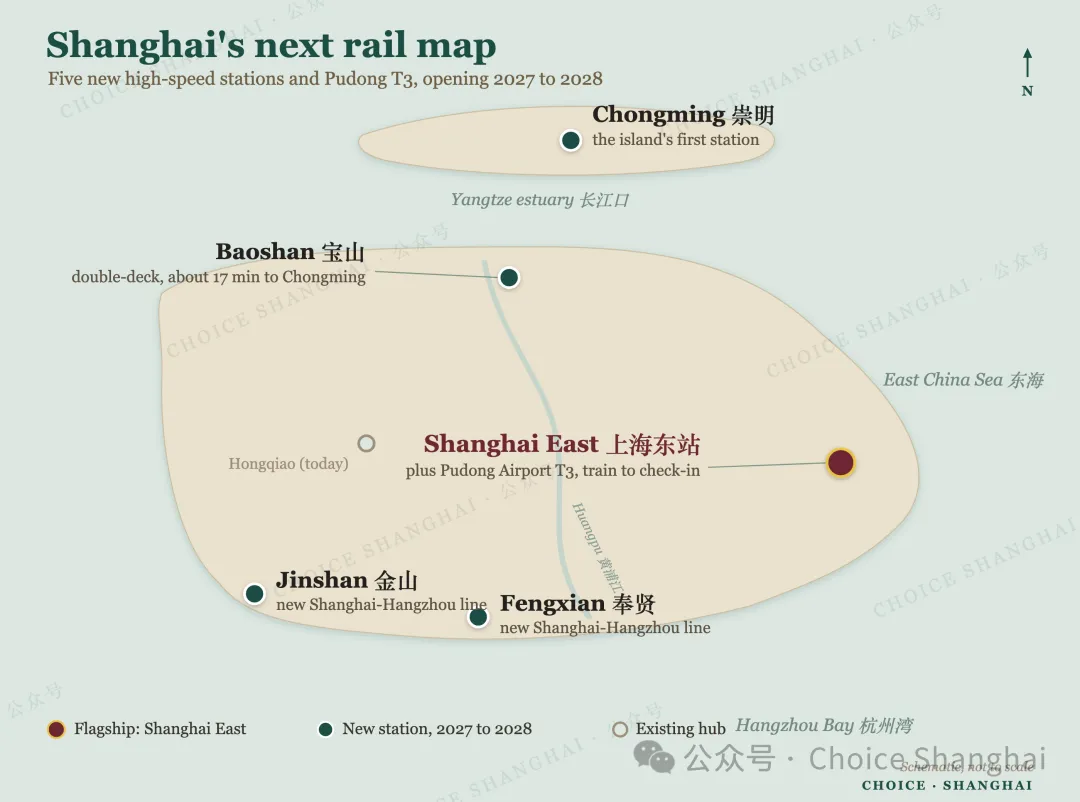
Why this page exists. Station locations, specifications and opening dates below are official planning targets as of 2026, and targets can move with construction and testing. Treat this as a practical orientation to the rail map taking shape — and check the latest announcements before you book anything around a new station.
1. The five new stations at a glance
Shanghai already has Shanghai Railway Station, Hongqiao, Songjiang and Shanghai South. The five additions split into two groups: three now under construction (Shanghai East, Baoshan, Chongming) and two still on paper (Jinshan, Fengxian, both on the new Shanghai-Hangzhou line).
| Station | Where | Main lines | Target opening |
|---|---|---|---|
| Shanghai East (上海东站) | Pudong, Zhuqiao — beside Pudong Airport | Shanghai-Nantong, new Shanghai-Hangzhou, Airport Link | July 2027 |
| Baoshan (宝山站) | Baoshan, Yanghang | Shanghai-Nanjing-Hefei, Shanghai-Nantong phase 2 | July 2027 |
| Chongming (崇明站) | Chongming, Chengqiao | Shanghai-Nanjing-Hefei | Not yet announced |
| Jinshan (金山站) | Jinshan | New Shanghai-Hangzhou line | Planned |
| Fengxian (奉贤站) | Fengxian | New Shanghai-Hangzhou line | Planned |
A few numbers worth knowing before the detail: at Shanghai East, the walk from your train to the airline check-in gate is about 250 metres; Baoshan becomes China's second double-deck station; and Chongming gets its first railway station, ever.
2. Shanghai East: the second-biggest hub in the city
Shanghai East Railway Station (上海东站) sits right beside Pudong International Airport, in Zhuqiao, Pudong. The scale is hard to picture: 15 platforms and 30 tracks, three levels above ground and three below, with roughly 1.33 million square metres of floor area. It becomes the city's second-largest transport hub after Hongqiao.
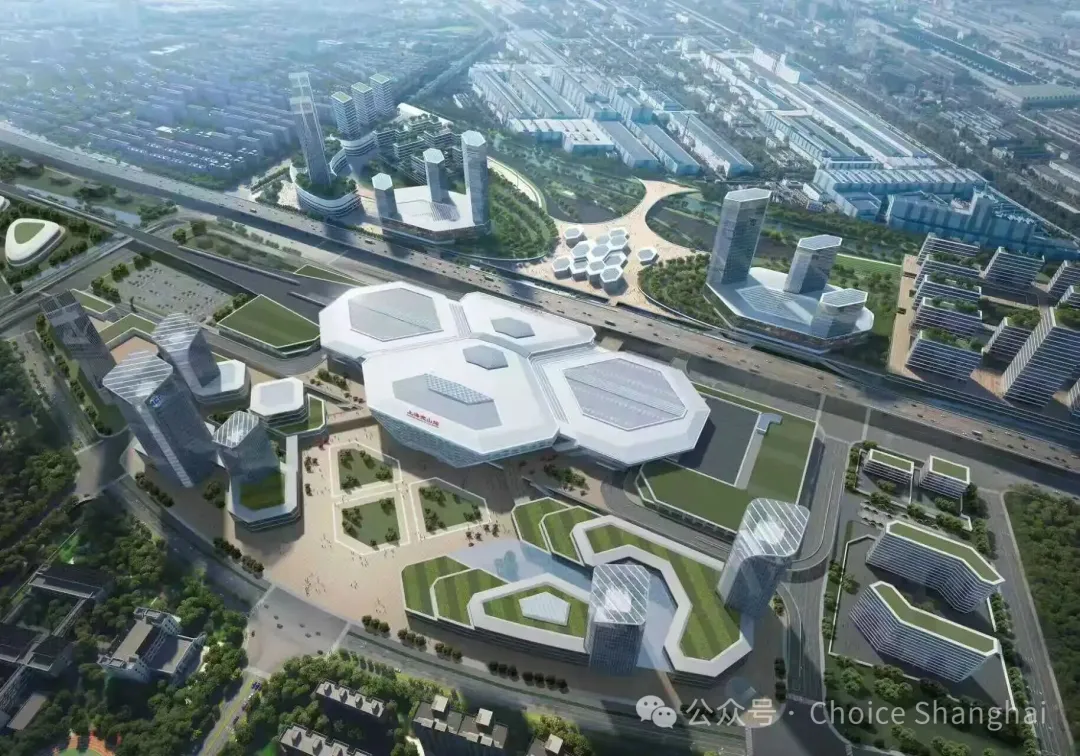
What makes it different is the air-rail link. Shanghai East is the first station in the city to fold in a dedicated air-travel module, so the walk from the rail exit to the underground airline check-in gate is only about 250 metres. You step off a train and check in for a flight without leaving the building. The lines here include the Shanghai-Nantong railway, the new Shanghai-Hangzhou line, the coastal routes north and south, and the Airport Link tying it to Hongqiao Station, Hongqiao Airport and Pudong Airport.
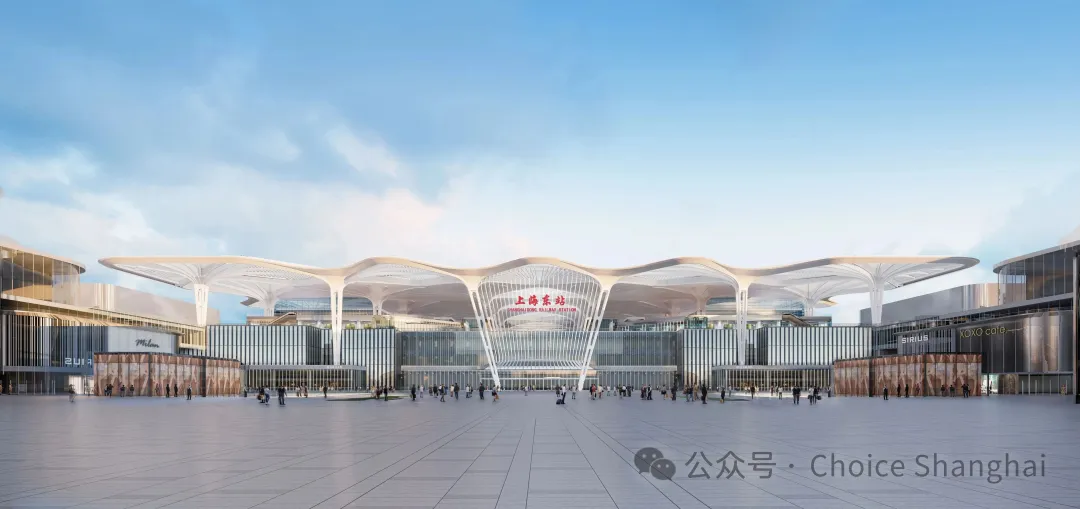
Target opening: July 2027. If you have ever sprinted a tight connection between a flight and a train, this one is built for you.
3. Baoshan: the double-deck station, also 2027
Baoshan Station (宝山站) is at Yanghang Town in Baoshan, near the G1503 Outer Ring and S20 expressways, where the Shanghai-Nanjing-Hefei high-speed line meets the second phase of the Shanghai-Suzhou-Nantong railway. With 8 platforms and 18 tracks, an 81,000 square metre concourse and 482,400 square metres in total, it becomes Shanghai's fourth-largest rail hub.
The clever bit is the layout: it is China's second station built on a double-deck track plan. The elevated level carries the Shanghai-Chongqing-Chengdu high-speed line (4 platforms, 8 tracks); the underground level takes the Shanghai-Nantong railway (4 platforms, 10 tracks). Baoshan is also the northern terminus of Metro Line 19, with room reserved for a future Baoshan-Jiading regional line.
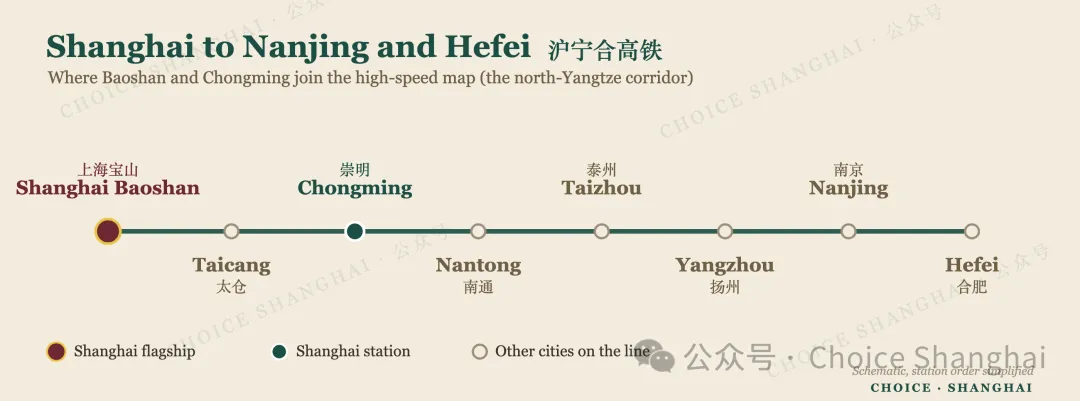
Target opening: July 2027, in step with Shanghai East.
4. Chongming: the island finally gets a station
Chongming Station (崇明站) sits in Wan Nan Village, Chengqiao Town, about 1.5 km from Chongming's main urban area. It is a new stop on the Shanghai-Nanjing-Hefei high-speed line, kept modest at 2 platforms and 6 tracks, with roughly 10,000 square metres of station building.
The design includes a train-turning facility, which matters more than it sounds: it opens the way for future intercity services shuttling between Chongming and central Shanghai. Bus bays, taxi ranks, parking and a public plaza come with it. No firm opening date has been published yet, but once the new cross-river tunnel is running, Chongming will sit about 17 minutes from Shanghai Baoshan — the island's first fast link into the mainland rail network.
5. Jinshan and Fengxian: the planned additions
Jinshan Station (金山站) will sit inside the block bounded by Hangzhou Bay Avenue, the G15 expressway, Tingwei Road and Caowei Road. It brings together the new Shanghai-Hangzhou high-speed line, the Shanghai-Zhapu-Hangzhou railway and the existing Jinshan railway, cutting travel times to the city centre and around Hangzhou Bay. Taxi, ride-hailing, bike parking and a bus depot are planned.
Fengxian Station (奉贤站) is another new stop on the same line, aimed at Fengxian New City. Detailed plans have not been released yet, so anything more specific for now is unofficial.
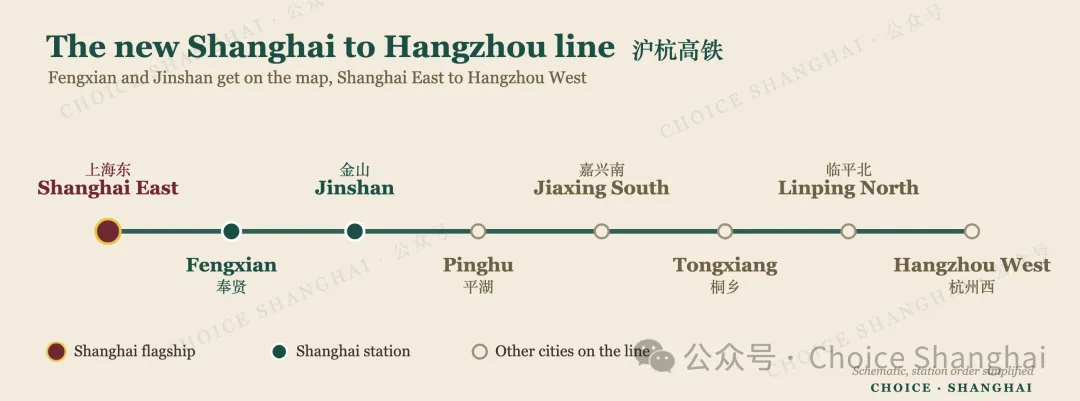
About that line: the new Shanghai-Hangzhou high-speed railway (earlier called the Shanghai-Zhapu-Hangzhou line) runs about 197 km from Shanghai East to Hangzhou West, 54 km of it in Shanghai. Design speed is 350 km/h, and when it opens it is expected to put Shanghai and Hangzhou roughly 40 minutes apart. It has nine stations: four new (Fengxian, Jinshan, Pinghu, Linping North), four rebuilt (Situan, Jiaxing South, Tongxiang, Hangzhou West) and one existing (Shanghai East).
6. Pudong Airport T3: the terminal that takes the pressure off
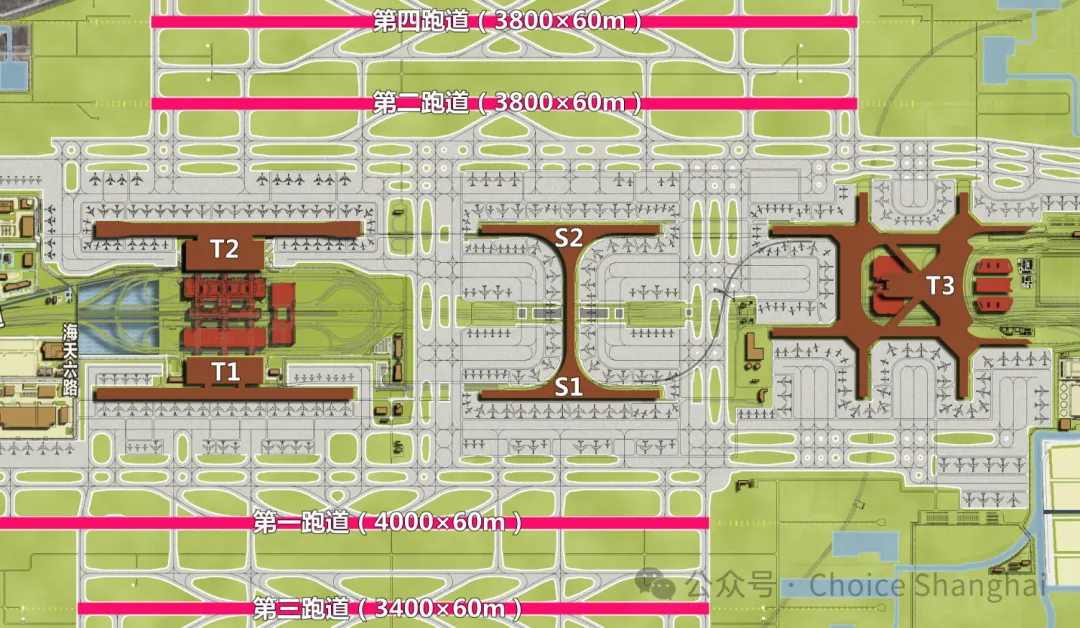
Pudong's new T3 terminal (浦东机场T3) is the centrepiece of the airport's Phase Four expansion, south of the existing T1, T2 and satellite hall. It is designed for 50 million passengers a year, and once it is done the airport can handle 130 million.
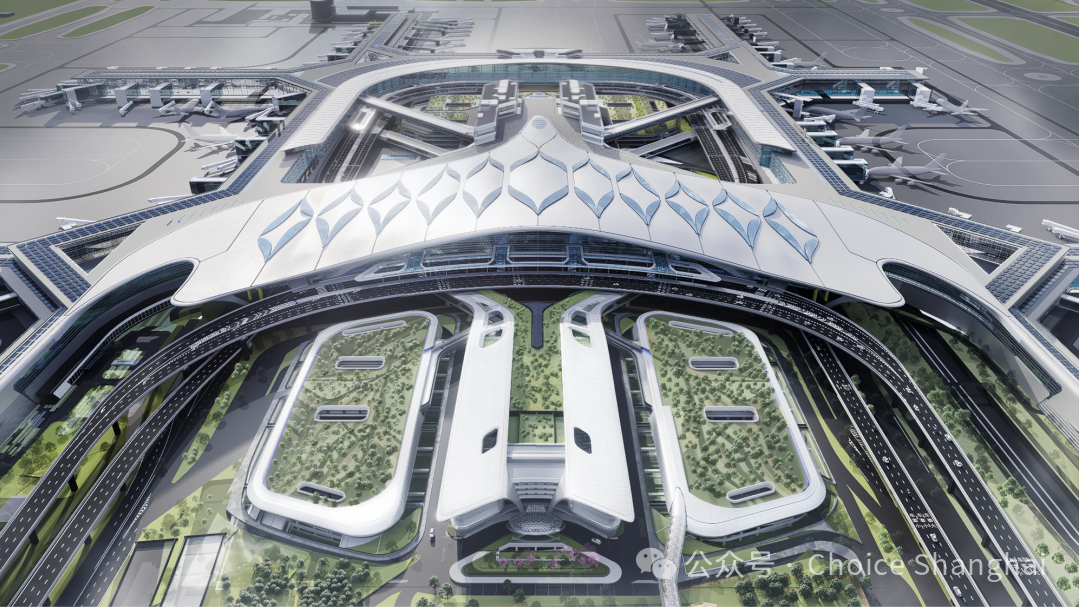
The roofline leans into a flight pose, echoing the spread-wings shapes of T1 and T2. When Phase Four finishes, Pudong will have three terminals, one satellite concourse and four runways, with more than 1.7 million square metres of terminal space. Construction started on 4 January 2022, and completion is expected in 2028.
7. What this means for living in Shanghai
If you live in Pudong or on the east side, Shanghai East cuts out the trip to Hongqiao entirely. In the north, Baoshan gives you a station instead of a long metro ride. On Chongming, you stop being the last stop before a ferry. And if you fly often, the 250-metre rail-to-check-in walk at Shanghai East is a genuinely new kind of connection for the city.
Here is the part that actually changes your week — the journey times once each line opens:
| Trip, once open | Line | Journey |
|---|---|---|
| Chongming to Shanghai (Baoshan) | Shanghai-Chongqing-Chengdu (北沿江) | about 17 min |
| Shanghai to Hangzhou | new Shanghai-Hangzhou line | about 40 min |
| Shanghai (Baoshan) to Nanjing, Hefei | Shanghai-Nanjing-Hefei line | direct, no transfer |
Further out, once the Shanghai-Hangzhou line opens, Jinshan and Fengxian turn into real commuter options rather than once-a-year day trips. If you are weighing where to live outside the centre, the rail map is quietly redrawing that maths.

8. Common questions
- When does Shanghai East Railway Station open?
- July 2027, per current official planning targets. It becomes the city's second-largest hub, and the first where you walk from the train straight to airline check-in for a flight.
- Can I catch a high-speed train from Pudong now, or do I still go to Hongqiao?
- For now, Hongqiao. High-speed passengers in Pudong still cross the city. Once Shanghai East opens in 2027, trains stop beside Pudong Airport and link through to Hongqiao.
- Which stations are under construction and which are still just planned?
- Under construction now: Shanghai East, Baoshan and Chongming. Still on paper with no start date: Jinshan and Fengxian, both on the new Shanghai-Hangzhou line.
- Is the new Shanghai-Hangzhou high-speed line open yet?
- Not yet. As of 2026 it is still under construction, running from Shanghai East to Hangzhou West with nine stations, and it is expected to cut the trip to about 40 minutes.
- When will Pudong Airport T3 open?
- 2028, as part of the airport's Phase Four expansion. It is built for 50 million passengers a year and lifts total capacity to 130 million.