
Whether you are a foreign professional working in China who wants your family to visit, or a Chinese citizen hoping to bring relatives here, the first step is picking the right visa category. China offers four family-related visas — Q1, Q2, S1 and S2 — grouped into two main types. Q visas are for family members of Chinese citizens and permanent residents; S visas are for family members of foreigners who are living in China on a work or study permit. From there, the planned length of stay decides whether you need a long-stay Q1/S1 or a short-stay Q2/S2.

Q Visa or S Visa: the one-question decision
The difference comes down to the inviter's status in China, not the applicant's nationality.
| Inviter's status in China | Visa type | Who it covers |
|---|---|---|
| Chinese citizen, or foreigner with Chinese permanent residence | Q visa | Family members visiting for reunion |
| Foreigner living in China on a valid work or study residence permit | S visa | Family members, dependents and people coming for private affairs |
Once you know the visa family, choose the duration:
- Stay over 180 days → Q1 or S1. After entry, you must apply for a residence permit.
- Stay up to 180 days → Q2 or S2. No residence permit is needed; leave China before the visa expires.
Residence-permit deadline: Q1 and S1 holders must apply for a residence permit at the local Exit-Entry Administration Bureau within 30 days of arrival. Missing the deadline counts as illegal residence.
Q Visa — for family of Chinese citizens and permanent residents
Q1 Visa · Long-term reunion
For stays over 180 days. Issued to family members of Chinese citizens or foreigners with permanent residence in China, plus people entering for foster care.
Eligible relatives: spouse, parents, children (adult children included), children's spouses, siblings, grandparents, grandchildren and parents-in-law.
Foster care note: only for foreign minors under 18.
Q2 Visa · Short-term visit
For stays up to 180 days. Issued to relatives of Chinese citizens or permanent residents living in China.
Eligible relatives: the official term "relatives" is interpreted broadly, so the pool is wider than the Q1 list in practice.
Required documents for Q visa
- Original passport and copies (valid for at least 6 months)
- Completed visa application form and a recent passport-style photo
- Invitation letter from the inviter in China
- Copy of inviter's Chinese ID card or Permanent Residence Permit
- Proof of family relationship (see notes below)
- For applicants under 18: birth certificate and copies of parents' passports / IDs
Relationship-proof tip: documents issued inside China (household register, domestic birth certificate) usually do not need notarization. Documents issued outside China generally need notarization and authentication — check the exact requirements at the local Chinese embassy or consulate. Hague Convention countries may use an Apostille instead of full consular authentication. Start this step 1–2 months early.
S Visa — for family of foreign workers and students
S1 Visa · Long-term stay
For stays over 180 days. Issued to the spouse, parents, children under 18 and parents-in-law of a foreigner residing in China for work or study, plus people coming for other private affairs that require long-term residence.
S2 Visa · Short-term stay
For stays up to 180 days. Covers the same family circle as S1 and can also be used for other private affairs such as marriage, inheritance, litigation or medical treatment.
Beyond family visits. S1 and S2 visas are not limited to family reunions. They can also be used for private matters like getting married, handling inheritance, participating in legal proceedings or seeking medical treatment. You will need supporting documents that match the stated purpose.
Required documents for S visa
- Original passport and copies (valid for at least 6 months)
- Completed visa application form and a recent passport-style photo
- Invitation letter from the foreign inviter in China
- Copy of inviter's passport and valid China residence permit (work or study type)
- Proof of family relationship, or supporting documents for the private affair
- For applicants under 18: birth certificate and copies of parents' passports
S1 relationship-proof exception: family-reunion applicants entering with an S1 visa are generally exempt from submitting a relationship certificate under current rules. Applicants coming for other private affairs must still provide relevant proof.
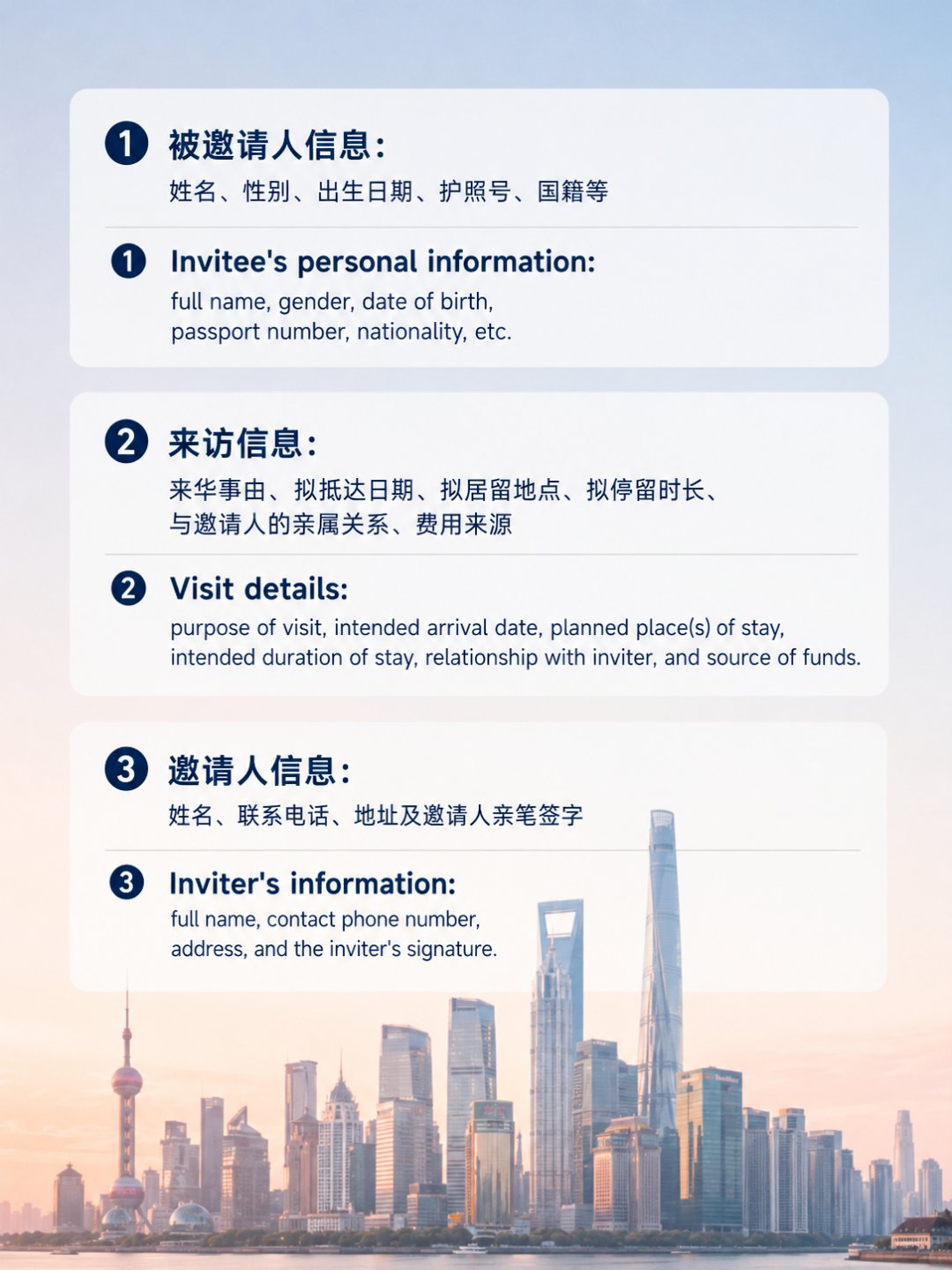
What the invitation letter must include
The invitation letter is the most important document for both Q and S visas. It should be complete, accurate and match the other application materials. Include the following:
Invitee information
Full name, gender, date of birth, passport number and nationality.
Visit details
Purpose of visit, planned arrival date, intended place of stay, intended duration, relationship to the inviter and source of funds.
Inviter information
Full name, contact phone number, address and the inviter's handwritten signature.
Consistency matters. Dates, names and addresses in the invitation letter should match the flight itinerary, accommodation records and any supporting documents. Mismatches are a common reason for delays or additional questions.
Common pitfalls to avoid
Do not work on a family visa
Q and S visas do not allow employment in China. Working on a family visa is illegal and can lead to fines, detention or deportation. The employer can also be held liable.
Overstaying is expensive
Under the Exit-Entry Administration Law, illegal stays of 10 days or less usually receive a warning. Over 10 days can cost RMB 500 per day, up to RMB 10,000, plus possible detention. Overstay records also hurt future applications.
Children and schooling
Children on Q1/S1 residence permits can attend international schools. Public-school admission varies by district; check with the local education authority before planning.
Extensions are possible
Q2/S2 visas can usually be extended at the local Exit-Entry Administration at least 7 days before expiry. Residence permits should be renewed about 30 days before expiry.
Frequently asked questions